
Philanthropic cultural capital
Emergent Cultural Capital is a series of funds that acquires artworks with strong growth potential, holds them for approximately seven years, lends them to museums where possible, and returns distributions to donor DAFs as philanthropic capital.
How it works
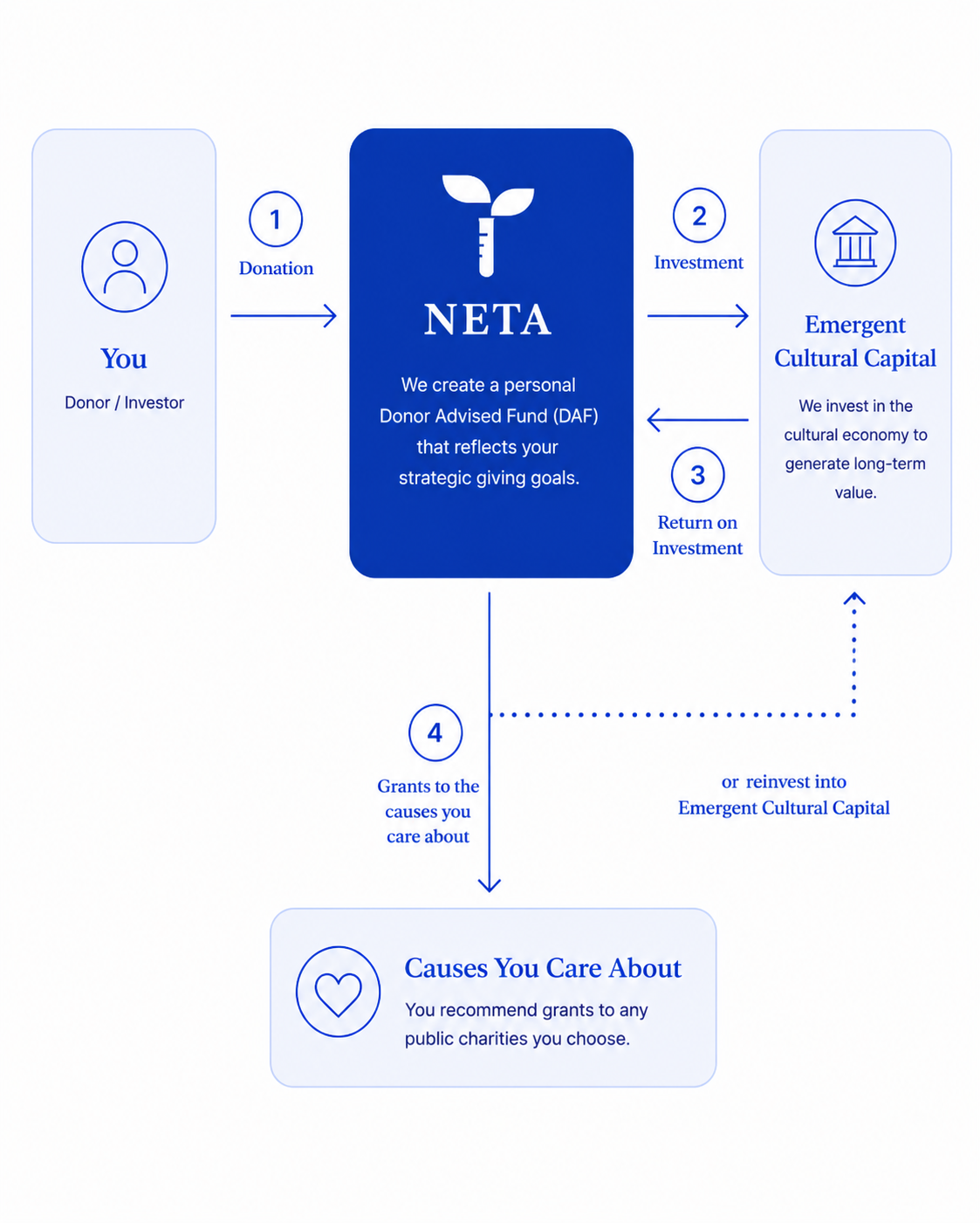
Consider the charitable impact of $1M, deployed two different ways.
1.
You give $1M to a cause you care about. The cause receives $1M and uses it. You take the charitable deduction. The dollar has done its work, once. It is gone.
2.
You give $1M to ECC. You take the charitable deduction. We deploy it into the art market. Over roughly seven years, the modeled return can bring approximately $3M back to your DAF as charitable capital.* You can then redeploy back into a ECC fund, or recommend grants from that $3M to any causes you choose. The same dollar has done three times the charitable work, while also generating revenue to the galleries that support them.

Emergent Cultural Capital is not a competitor to your other philanthropy. It is the engine that fuels it.
How it worksFor individuals: contributions into Neta are tax deductible** For private foundations: contributions into Neta count towards the 5% minimum annual distribution requirement***

Neta’s philanthropic leadership
A donor-advised fund (DAF) is a charitable savings account held at a 501(c)(3) sponsor. In this case, that sponsor is the Neta Foundation. As part of joining, Neta opens a DAF in your name.
Neta Foundation then becomes your charitable asset manager, pioneering a new approach to philanthropy. As the first platform designed to help donors discover and invest in impactful companies, research, and technologies, Neta expands the toolkit for driving meaningful change.
By bridging the worlds of philanthropy and investing, Neta enables donors to support the causes they care about while participating in innovative solutions. This convergence of granting and investing has given rise to a new category: GrantVestments™.
Through your individual DAF, you can track your investments' performance and redeploy returns to amplify your long-term impact.
Definitions
-
The same charitable dollar deployed and returned multiple times. A traditional grant gives once. ECC aims to return roughly three times the original contribution back to the donor's DAF, available for future grants to any cause.
-
A charitable savings account. You contribute, take the tax deduction at contribution, and then recommend grants from the account to causes you care about over time. The DAF sponsor (Neta, for this fund) is a 501(c)(3) charitable organization that legally holds the funds.
-
A US tax-exempt charitable organization. Neta Foundation is a 501(c)(3). Contributions to a 501(c)(3) are tax-deductible.
-
The 501(c)(3) partner. Holds donor DAFs, deploys capital into ECC, and routes distributions back into donor DAFs.
-
Neta Foundation's program for actively deploying donor-advised capital into mission-aligned investment vehicles, including Emergent Cultural Capital. The structural innovation that makes a fund like this possible.
-
The price an asset would sell for in an open market. Charitable deduction is taken at fair-market value for appreciated assets contributed to a DAF.
Any questions? We would love to hear from you.
*This is an estimate based on certain modeled assumptions, and used as an example only. Actual results will vary, and may be lower.
** Contributions to Neta are tax deductible to the extent allowed by federal law. Individuals should consult their tax advisor to determine their own ability to deduct contributions, based on their own specific circumstances.
*** Foundations should consult their tax advisor to determine their specific requirements related to minimum distributions.
Any discussions of tax matters in this presentation are for illustrative purposes only and pertain solely to federal tax law. Specific examples are linked to several assumptions which vary from donor to donor and from time to time, so results will vary. The availability and extent of any federal tax deductions depend on each donor’s individual tax situation. Potential donors to Neta are encouraged to consult their own tax advisors to evaluate their personal tax circumstances and the potential implications of establishing or contributing to a DAF.