We select high-growth, mid-career artists with a diligent dual-lens approach.
Quantitative: an in-house predictive model, the Artist Trajectory Score (ATS), identifies artists demonstrating strong institutional and market momentum.

Qualitative: our principals and advisory board apply curatorial expertise and market insight to refine selections and validate conviction.
The most compelling opportunities in the art market are often found in the mid-tier. While total performance can make this segment appear unattractive, the top decile of artists within the $25K–$500K market has generated the highest returns across the entire art market. The investable thesis is selection: identifying artists with the potential to break out from the mid-tier and achieve institutional and market recognition before prices catch up.

The Artist Trajectory Score (ATS) is our quantitative layer.
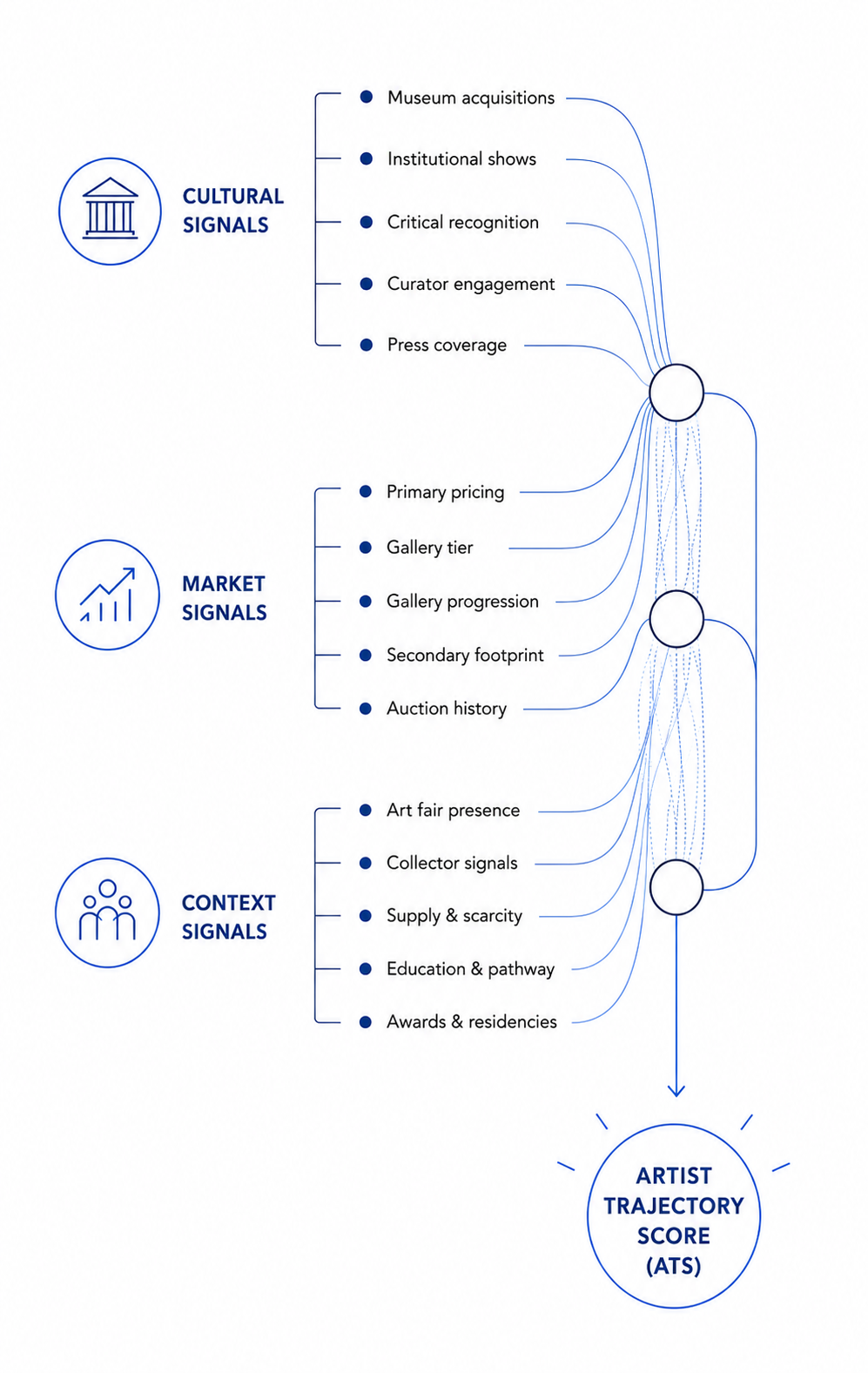
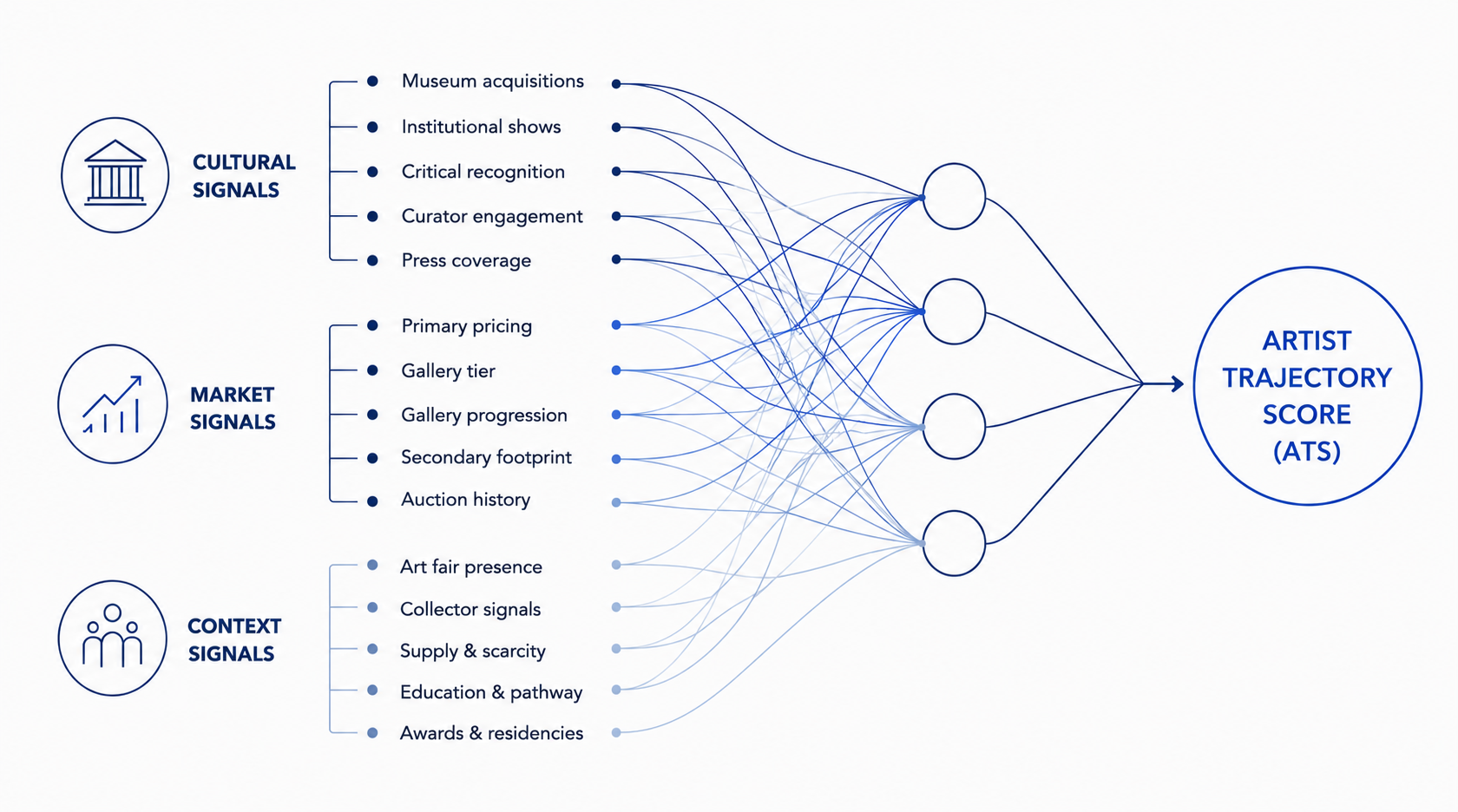
The ATS identifies artists with exceptional growth potential by continuously analyzing three pillars of signals across the global art ecosystem.
Bias SensitiveEach artist is assigned a representation diagnostic and tagged across the following dimensions:
Identity. Who the artist is, in the dimensions that have historically shaped access to the art world: race and ethnicity, gender, sexual orientation, nationality, and cultural origin.
Pathway. How the artist arrived at their professional position: type of training (formal MFA, self-taught, apprenticeship, immigrant pathway), early-career origin (blue-chip gallery debut, artist-run space, no representation), access to fellowships, residencies, and early patron support.
Practice. The nature of the work itself: medium, subject, size, and format.
Access. The structural advantages and barriers the artist navigates outside the studio: geographic location relative to art-market centers, gallery representation history, economic and network resources.


The ATS consistently identified artists ahead of major market recognition. In historical testing, a large majority of artists flagged by the model later experienced significant appreciation in value.*

Our advisory board comprised of cultural leaders guides our selection.
Helen Molesworth and three additional cultural leaders review every shortlist on a published rubric.
Helen Molesworth anchors the Advisory Board as our First Advisor. Former Chief Curator at MOCA Los Angeles and the ICA Boston, with earlier roles at the Harvard Art Museums and the Wexner Center for the Arts. A leading scholar and champion of under-represented voices in contemporary art.
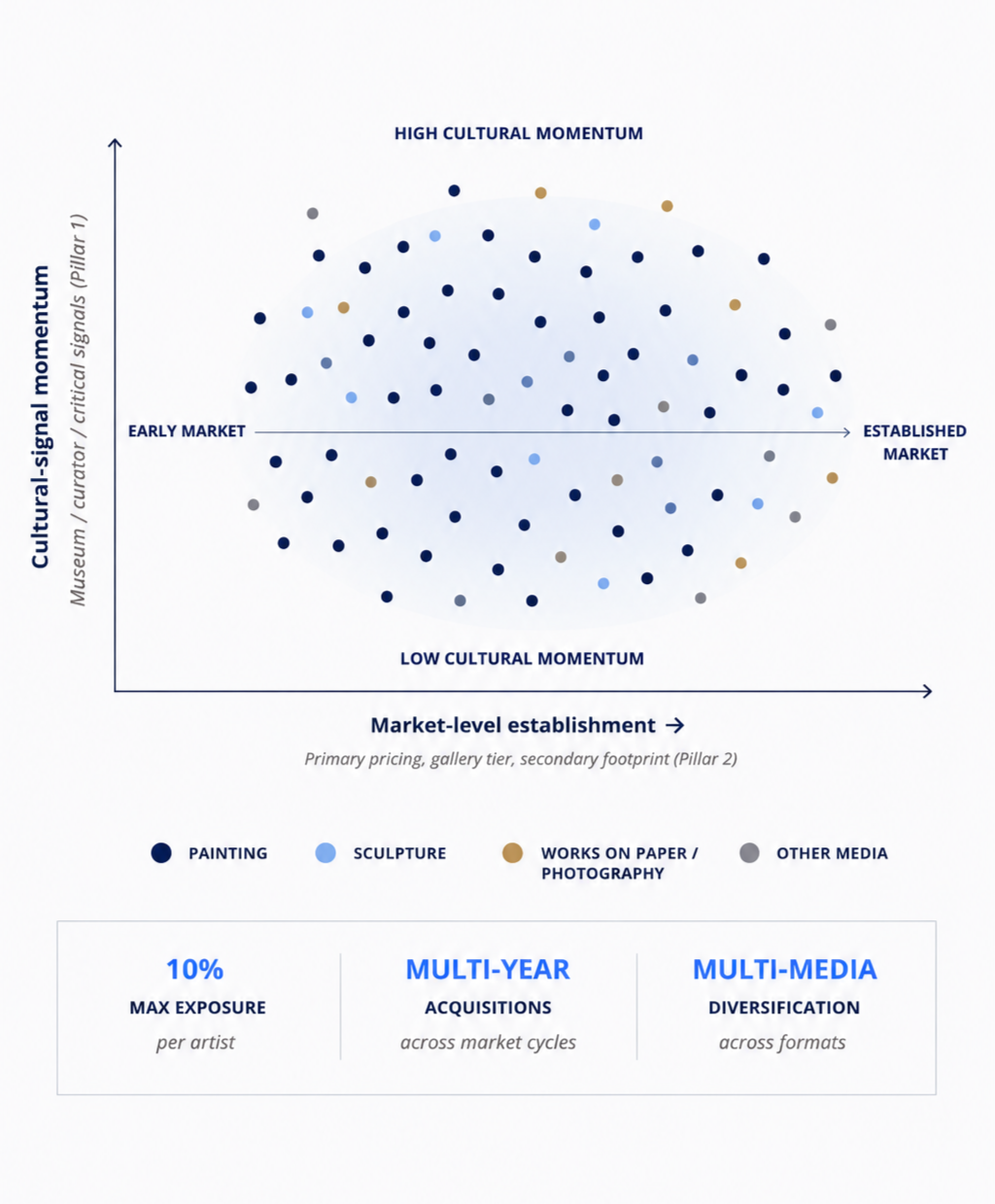
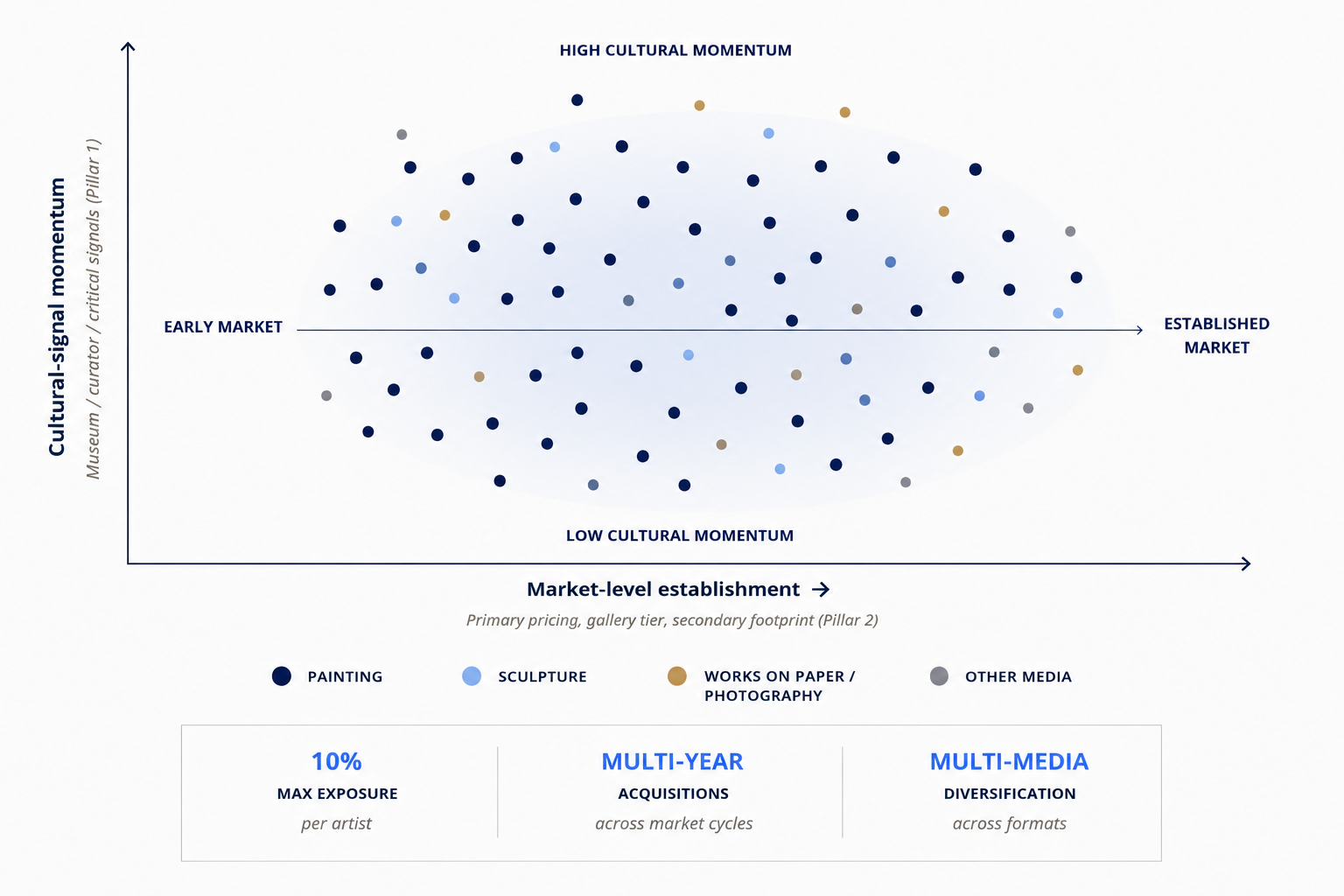
A diversified portfolio.
by definition minimizes risk, while optimizing return.
Definitions
-
EAA's proprietary quantitative model of fifteen dimensions across three pillars (cultural, market, context). Identifies artists with rising trajectory before public price discovery.
-
The curatorial review body for the fund. Three to five members, chaired by Helen Molesworth. Pressure-tests selection; no veto on individual acquisitions.
-
A gallery that builds artists into museum-relevant careers through multi-year programs. Typically priced $25K-$500K, often family-owned, usually have been around for at least a decade.
-
The band of contemporary art priced roughly $25,000 to $500,000. Distinct from blue-chip (top-tier auction trade) and emerging (works under about $25,000).
-
A report generated alongside each ATS shortlist showing how the selected artists distribute across identity, pathway, practice, and access dimensions, relative to the candidate universe.
-
A specific year's funding cycle of the program. Vintage I is Fund I. The program is designed to run fifteen vintages over twenty-five years.
*Results from a back-testing exercise checking 1033 artists with market signals from 2018-2022. Past results do not guarantee future results. Actual results will vary, and may be worse.